How Ship's Bell Time Works.
Time Kept by Sound, Not by Sight.
For most of seafaring history a sailor could not glance at a watch. Clocks were rare, expensive and unreliable on a rolling deck, and most of the crew were below, aloft, or working in the dark. What everyone could do was hear. So ships kept time out loud: a bell, hung where it carried across the whole vessel, struck at every half hour of the day and night.
The half hour came from the instrument that measured it, the half-hour sandglass, or simply "the glass." When the sand ran through, the ship's boy or the quartermaster turned the glass and struck the bell. Eight turns of the glass made a four-hour watch, the length of a shift on deck, and so the bell's count ran from one to eight before starting over. The glass is long gone, but the count survived it, and navies around the world still strike the ship's bell this way today.
It is a remarkably good system. You do not need to know the hour to know where you are in your watch, which is what actually matters on board: three bells means an hour and a half done; seven bells means half an hour until relief. And because every watch is the same length, the same eight-bell count works around the clock.
Ding-Ding, Pause, Ding-Ding.
The strokes are never struck as one long run. They are grouped into pairs, with a short gap between each pair and any odd stroke left over at the end. Counting pairs is far easier than counting single strokes, especially half-asleep in a hammock: two pairs and a single is unmistakably five.
That means you can tell the half hour from the hour by ear alone. An odd number of bells always falls on the half hour (:30) and ends with a lone stroke. An even number always falls on the hour (:00) and ends with a complete pair.
Tap any row to hear it the way Ship's Clock strikes it.
Seven Watches Around the Clock.
The ship's day is divided into watches, periods when one part of the crew has charge of the deck while the others eat, sleep and work. Five of them last four hours. The fifth four-hour block, from 16:00 to 20:00, is split into two short dog watches, making seven in all.
Each watch has a name that sailors still use. The bell count restarts with every watch, so "four bells in the forenoon watch" pins down the time exactly: 10:00 in the morning.
The first night watch. Its eight bells at midnight mark the start of a new day.
The "mid watch," long called the graveyard watch: the quietest, hardest hours to stay awake.
Dawn on deck. Traditionally the decks were scrubbed down before the rest of the crew turned out.
Ends with eight bells at noon, when navigators took the sun's height to fix the ship's latitude.
The long middle of the working day, from noon sight to the evening dog watches.
The first of the two short watches that shift the rota and let both watches eat supper.
Also called the second dog watch. In the Royal Navy its bells are struck in a special way (see below).
The Full Ship's Bell Chart.
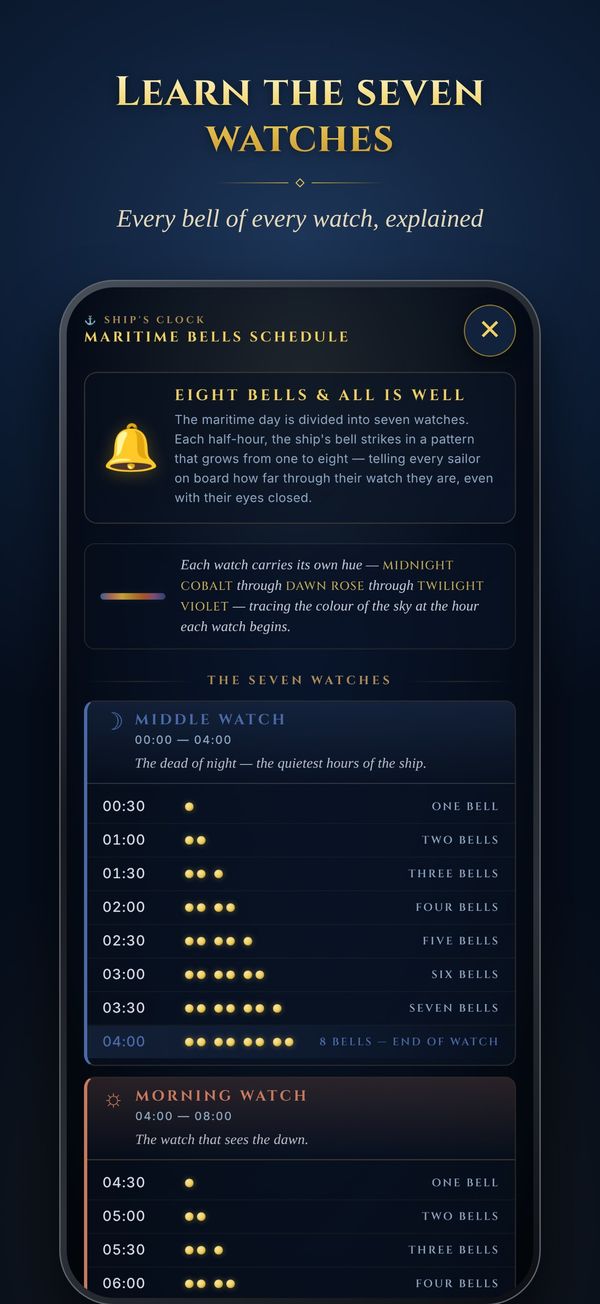
Every half-hour bell of the day, with 24-hour and 12-hour time. Eight bells are highlighted in gold; the bell most recently struck where you are is highlighted in orange. This chart follows the common U.S. and merchant practice of counting straight through the dog watches.
| 24-hour | Clock time | Bells | Watch |
|---|---|---|---|
| 0030 | 12:30 AM | One bell | Middle |
| 0100 | 1:00 AM | Two bells | Middle |
| 0130 | 1:30 AM | Three bells | Middle |
| 0200 | 2:00 AM | Four bells | Middle |
| 0230 | 2:30 AM | Five bells | Middle |
| 0300 | 3:00 AM | Six bells | Middle |
| 0330 | 3:30 AM | Seven bells | Middle |
| 0400 | 4:00 AM | Eight bells | Middle |
| 0430 | 4:30 AM | One bell | Morning |
| 0500 | 5:00 AM | Two bells | Morning |
| 0530 | 5:30 AM | Three bells | Morning |
| 0600 | 6:00 AM | Four bells | Morning |
| 0630 | 6:30 AM | Five bells | Morning |
| 0700 | 7:00 AM | Six bells | Morning |
| 0730 | 7:30 AM | Seven bells | Morning |
| 0800 | 8:00 AM | Eight bells | Morning |
| 0830 | 8:30 AM | One bell | Forenoon |
| 0900 | 9:00 AM | Two bells | Forenoon |
| 0930 | 9:30 AM | Three bells | Forenoon |
| 1000 | 10:00 AM | Four bells | Forenoon |
| 1030 | 10:30 AM | Five bells | Forenoon |
| 1100 | 11:00 AM | Six bells | Forenoon |
| 1130 | 11:30 AM | Seven bells | Forenoon |
| 1200 | 12:00 PM | Eight bells | Forenoon |
| 24-hour | Clock time | Bells | Watch |
|---|---|---|---|
| 1230 | 12:30 PM | One bell | Afternoon |
| 1300 | 1:00 PM | Two bells | Afternoon |
| 1330 | 1:30 PM | Three bells | Afternoon |
| 1400 | 2:00 PM | Four bells | Afternoon |
| 1430 | 2:30 PM | Five bells | Afternoon |
| 1500 | 3:00 PM | Six bells | Afternoon |
| 1530 | 3:30 PM | Seven bells | Afternoon |
| 1600 | 4:00 PM | Eight bells | Afternoon |
| 1630 | 4:30 PM | One bell | First Dog |
| 1700 | 5:00 PM | Two bells | First Dog |
| 1730 | 5:30 PM | Three bells | First Dog |
| 1800 | 6:00 PM | Four bells | First Dog |
| 1830 | 6:30 PM | Five bells | Last Dog |
| 1900 | 7:00 PM | Six bells | Last Dog |
| 1930 | 7:30 PM | Seven bells | Last Dog |
| 2000 | 8:00 PM | Eight bells | Last Dog |
| 2030 | 8:30 PM | One bell | First |
| 2100 | 9:00 PM | Two bells | First |
| 2130 | 9:30 PM | Three bells | First |
| 2200 | 10:00 PM | Four bells | First |
| 2230 | 10:30 PM | Five bells | First |
| 2300 | 11:00 PM | Six bells | First |
| 2330 | 11:30 PM | Seven bells | First |
| 2400 | 12:00 AM | Eight bells | First |
Quick rule: take the hours and minutes since the start of the current watch (00, 04, 08, 12, 16 or 20 o'clock), count the half hours, and that number is the bell. 14:30 is two and a half hours after 12:00, five half hours, so five bells.
Why There Are Dog Watches.
Six four-hour watches would divide the day neatly, but they would also chain each sailor to the same hours for the whole voyage. If you stood the middle watch on Monday, you would stand it every night until you reached port.
Cutting the 16:00–20:00 watch in two creates seven watches, an odd number. With a crew split into two watches taking turns, an odd number of watches means the duty times shift by one every day, so the misery of the middle watch is shared around. The short evening watches also let each half of the crew get its supper at a reasonable hour.
Nobody knows for certain where the name comes from. Popular explanations include "dodge watch," a short "dog sleep," or a pun on the Dog Star, but the earliest sources do not settle it. By the 1700s the custom was nearly universal among European sailors.
The Royal Navy's 1-2-3-8
Most ships simply count on through the dog watches: one to four bells in the first dog, then five to eight in the last. The Royal Navy does it differently. In the last dog watch it strikes one bell at 18:30, two at 19:00, three at 19:30 and eight at 20:00. Tradition ties this to the great naval mutiny at the Nore in 1797, where five bells in the second dog watch is said to have been the signal to rise. Ever since, the story goes, five bells has never been struck in that watch. Flip the Royal Navy dog watch switch at the top of this page to see it.
| Time | U.S. & most ships | Royal Navy |
|---|---|---|
| 16:30 | 1 bell | 1 bell |
| 17:00 | 2 bells | 2 bells |
| 17:30 | 3 bells | 3 bells |
| 18:00 | 4 bells | 4 bells |
| 18:30 | 5 bells | 1 bell |
| 19:00 | 6 bells | 2 bells |
| 19:30 | 7 bells | 3 bells |
| 20:00 | 8 bells | 8 bells |
Ship's Bells vs. Military Time.
People often mix up ship's bell time and the 24-hour clock because sailors use both. They answer different questions. The 24-hour clock tells you the time of day; the bell tells you how far you are through your watch.
| Ship's bell time | 24-hour (military) time | |
|---|---|---|
| Unit | Half hours within a 4-hour watch | Hours and minutes since midnight |
| Range | 1 to 8 bells, repeating six times a day | 0000 to 2359, once a day |
| How you get it | By ear, anywhere on the ship | By looking at a clock |
| Example: 14:30 | Five bells in the afternoon watch | Fourteen-thirty |
| Example: noon | Eight bells, end of the forenoon watch | Twelve hundred |
Special Bells and What They Mean.
By naval tradition the bell is struck sixteen times at the turn of the year, eight for the old year and eight for the new, often by the youngest sailor aboard.
A vessel at anchor in fog rings the bell rapidly for about five seconds at least once a minute, under Rule 35 of the international collision regulations. Vessels 20 metres and longer must carry a bell (Rule 33).
In the U.S. Navy the bell is rung in pairs as a commanding officer or flag officer comes aboard or leaves, followed by an announcement of their command.
Quick, continuous strokes, very different from the steady pairs of the time signal, have long been used to raise the alarm for fire.
Because eight bells ends a watch, "eight bells" has become the mariner's phrase for a life at sea come to its end, and eight bells are often struck at memorials.
The bell of HMS Lutine, wrecked in 1799, hangs at Lloyd's. It was once struck once for a ship lost and twice for an overdue ship safely home. Today it marks special occasions. Read its story.
Ship's Bell Clocks, Then and Now.
A ship's bell clock is a clock that strikes the watch pattern for you, one to eight bells on the half hour and hour, instead of chiming the hours. The Chelsea Clock Company of Massachusetts patented an encased striking ship's bell movement in 1900, and by the following years the U.S. Navy was ordering its marine clocks in quantity. Brass bell clocks became a fixture of wardrooms, yacht saloons and, eventually, the studies and offices of people who had never been to sea.
Many people first meet ship's bell time through one of these clocks, and are puzzled when it strikes "two" at 1:00 or 9:00. Now you know why: it is counting half hours into the watch.
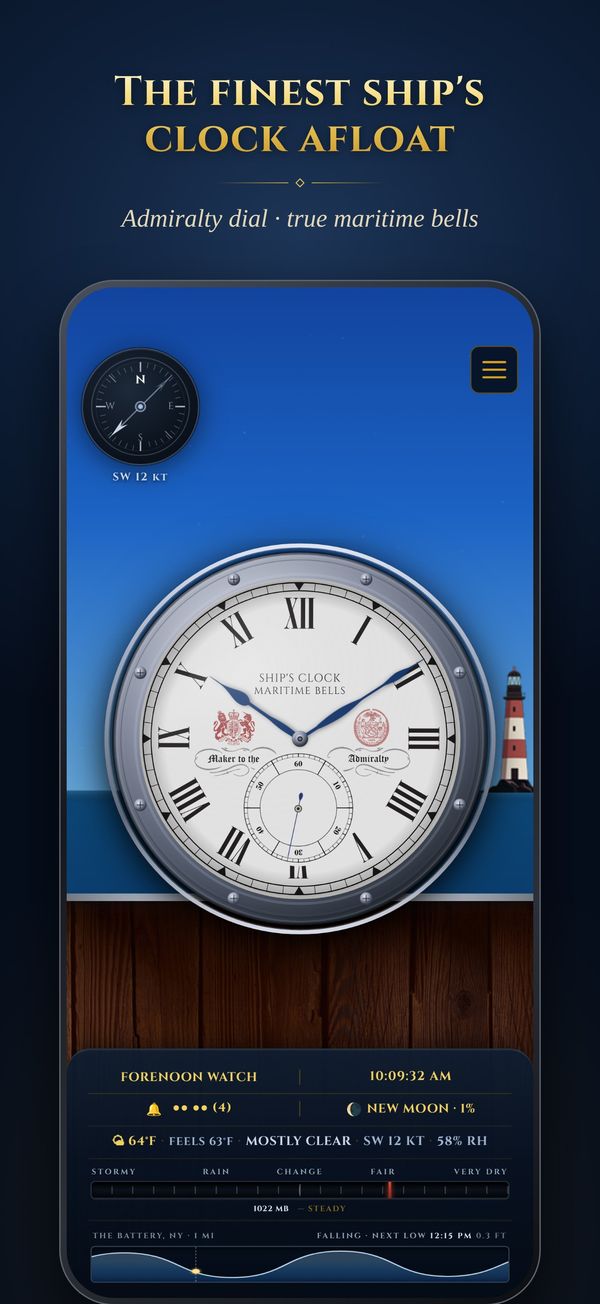
Ship's Clock brings the same tradition to your phone. It strikes the authentic watch pattern every half hour in pairs, shows the current watch name, and keeps ringing in the background and on the lock screen. Night silence keeps the middle watch quiet, and you can choose the Royal Navy or U.S. style for the dog watches.


Watch a Ship's Clock Keep the Watch.
Ship's Bell FAQ.
What does "eight bells" mean?
How do ship's bells tell time?
How many bells is 10:30? What about 3:00?
Why does my ship's bell clock strike two at one o'clock?
What is a dog watch?
Why are the bells struck in pairs?
Why do ships ring 16 bells on New Year's Eve?
Is there an app that rings ship's bells?
From the half-hour sandglass and the longitude prize to the Lutine Bell and the striking clocks of the U.S. Navy.
Hear the watches ring on your phone, with Admiralty chronometer dials, tides, weather and moon.
Hear the Watches Ring.
Ship's Clock strikes the ship's bells every half hour on iPhone, Android and the web. Free to try, then one purchase for life. No subscription, no ads.