Five Centuries of Ship's Bells.
Long before anyone at sea owned a watch, a ship told the time out loud. This is the story of the bell that did it: the sandglass behind it, the watches it marked, the clockmaker who finally gave sailors the time itself, and the customs the bell still carries today.
A Timeline of Time at Sea.
Ships time their watches with sandglasses. Each turn of the half-hour glass is announced on the bell, by at least the fifteenth century.
One of the earliest recorded ship's bells hangs aboard the English ship Grace Dieu. About ten years later an inventory of the Regent lists two "wache bells."
Splitting the evening watch in two is nearly universal among European sailors, so the crew's hours rotate day by day.
Britain offers £20,000 for a practical way to find longitude at sea to within thirty nautical miles.
John Harrison's sea watch H4 arrives about five seconds slow after roughly two months at sea, an error of only a couple of miles of longitude.
James Cook sails his second voyage with K1, Larcum Kendall's copy of H4, and proves that a timekeeper can navigate the world.
After the mutiny at the Nore, tradition holds, Royal Navy ships stop striking five bells in the last dog watch. They ring one, two, three, then eight.
Revere casts a 242-pound bell for the frigate USS Constitution.
The frigate is wrecked in a gale off the Dutch coast on 9 October. Her bell is recovered in 1858 and taken to Lloyd's of London.
British naval regulations make ringing the bell in fog mandatory.
The Chelsea Clock Company opens in Massachusetts and patents an encased ship's bell striking movement in 1900. Navy orders follow within a few years.
The international collision regulations require vessels 20 metres and longer to carry a bell, and set the fog signals still used today.
Ship's Clock strikes the watch pattern on iPhone, Android and the web, every half hour, in pairs.
Turning the Glass.
A pendulum clock is useless on a ship. Every roll and pitch throws it off, and early mechanical clocks were too costly and fragile for life at sea anyway. The tool that worked was the sandglass: two glass bulbs and a measured run of sand that kept the same pace whether the deck was steady or heaving.
Ships carried several. A half-hour glass kept the watch; much shorter glasses timed the log line that measured the ship's speed in knots. When the half-hour glass ran out, the ship's boy or the quartermaster turned it and struck the bell, once for each half hour that had run in the watch. Eight turns and eight bells made a four-hour watch, and the count began again.
Sailors being sailors, the glass invited cheating. "Flogging the glass" meant shaking or warming it so the sand ran faster and a tired watch ended sooner. The phrase outlived the instrument by centuries.
Why the strokes come in pairs
A tired sailor counting single strokes in the dark could easily lose count. Grouping them into pairs, ding-ding, ding-ding, ding, made the count easy to hear and hard to get wrong. Navies still strike the bell that way. See how to read the pairs.
The Watch System.
A ship never sleeps, so neither can its crew all at once. The answer, refined over centuries, was to split the company into watches that took turns on deck: four hours on, then time below to eat, sleep and mend. Five of the day's watches run four hours. The sixth, from 16:00 to 20:00, is split into two short dog watches.
That split is the clever part. With seven watches a day instead of six, a crew working in two halves gets a different set of hours each day, so nobody is stuck with the dreaded middle watch, midnight to four, for an entire voyage. It also means both halves of the crew can eat supper at a decent hour. Britannica notes the origin of the dog watch is unknown, but by the eighteenth century it was nearly universal among European and Mediterranean sailors.
| Watch | Hours | Known for |
|---|---|---|
| First Watch | 20:00–24:00 | The first night watch; its eight bells mark midnight |
| Middle Watch | 00:00–04:00 | The "graveyard watch," the hardest to stay awake through |
| Morning Watch | 04:00–08:00 | Dawn, and traditionally scrubbing the decks |
| Forenoon Watch | 08:00–12:00 | Ends at noon, when the sun was measured for latitude |
| Afternoon Watch | 12:00–16:00 | The working afternoon |
| First Dog | 16:00–18:00 | The first of the two short watches |
| Last Dog | 18:00–20:00 | Royal Navy: struck 1, 2, 3 and then 8 bells |
The full bell-by-bell chart, and a live dial showing which watch is on deck where you are right now, is on our guide to ship's bell time.
Longitude and the Chronometer.
A navigator could find latitude, how far north or south he was, from the height of the sun at noon. Longitude, east or west, was another matter. The Earth turns fifteen degrees an hour, so longitude is really a question of time: compare local noon with the time at your home port, and the difference tells you how far round the world you are. That needs a clock that keeps home-port time for months at sea, through heat, cold and storms. No such clock existed.
Ships ran aground on coasts they believed were days away. In 1714 the British Parliament passed the Longitude Act, offering £20,000 for a practical method accurate to within thirty nautical miles.
The man who claimed it was John Harrison, a self-taught carpenter-turned-clockmaker from Yorkshire. His first three sea clocks were large, brilliant machines. His fourth, H4, was a watch you could hold in your hand. Sent to Jamaica in 1761, it arrived after about two months at sea only about five seconds slow, a longitude error of roughly two miles. The Board of Longitude made him wait. He received a partial payment after a second trial, and Parliament paid the balance in 1773, three years before he died.
Captain James Cook took K1, Larcum Kendall's copy of H4, on his second voyage from 1772. Its success settled the argument, and the marine chronometer, kept in a gimballed box and wound at the same hour every day, became standard equipment on ocean-going ships for the next two centuries. The chronometer kept the ship's navigation time. The bell still kept the crew's.
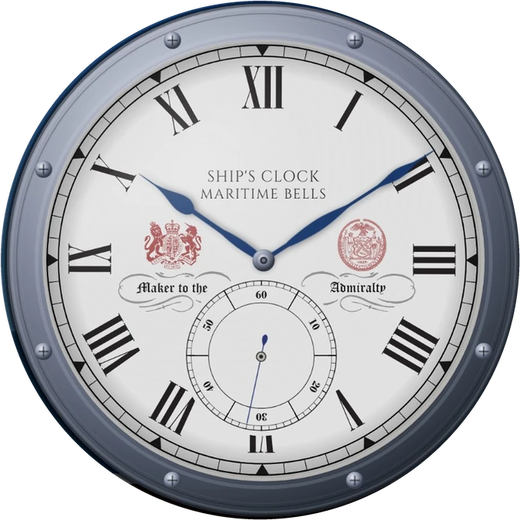
The Bell Is the Ship's Soul.
Of everything aboard, the bell is the part most closely tied to the ship's identity. It is usually cast or engraved with the ship's name and year, and naval tradition has long regarded it as the vessel's soul. When a ship is decommissioned or lost, its bell is often what survives. The U.S. Navy's Naval History and Heritage Command keeps the bells of decommissioned ships as government property and lends them to new ships of the same name, to commands and to museums, so a bell can serve generation after generation of the same name.
A sailor's child may be baptised with the ship's bell turned over as a font, and the child's name engraved inside it afterwards. Some old bells carry dozens of names.
In the U.S. Navy the bell is rung in pairs as a commanding officer or flag officer arrives or departs, followed by an announcement of their command.
Eight bells for the old year and eight for the new, traditionally struck by the youngest member of the crew.
"Eight bells" became sailors' shorthand for a life at sea ended, and eight bells are struck at memorials and funerals.
The Lutine Bell.
On the evening of 9 October 1799 the frigate HMS Lutine was driven onto the sandbanks off the Dutch coast in a heavy gale and lost, together with a large cargo of gold and silver insured at Lloyd's of London. The bell was recovered from the wreck in 1858 and hung at Lloyd's.
For generations it was rung to announce news of overdue ships: once for a ship lost, twice for her safe return, so every broker and underwriter in the room heard the news at the same moment. It no longer brings news of ships. Today it is rung for special occasions, and it remains the most famous ship's bell on land.
"Once for a loss. Twice for a return."
Bells in the Fog.
When a ship cannot see, it has to be heard. Ringing the bell in fog to warn other vessels was customary long before it was law. British naval regulations made it mandatory in 1858. Today the International Regulations for Preventing Collisions at Sea (COLREGs) set the rules: under Rule 33 a vessel 20 metres or longer must carry a bell, and one of 100 metres or more a gong as well. Under Rule 35 a vessel at anchor in restricted visibility rings the bell rapidly for about five seconds at intervals of not more than one minute.
That rapid ringing sounds nothing like the steady pairs of the time signal, which is the point: no one should ever mistake a warning for the time.
Ship's Bell Clocks Come Ashore.
By the late 1800s clocks were finally good enough, and cheap enough, to strike the bells themselves. The Chelsea Clock Company, founded in Chelsea, Massachusetts in 1897, patented an encased ship's bell striking movement in 1900. Within a few years the U.S. Navy was ordering its marine clocks in growing numbers, and other services followed.
The brass ship's bell clock became a classic: on bridges and in wardrooms, then in yacht saloons, offices and homes, given as retirement gifts to sailors and kept by people who simply loved the sound. Its odd habit of striking "two" at one o'clock has puzzled houseguests ever since.
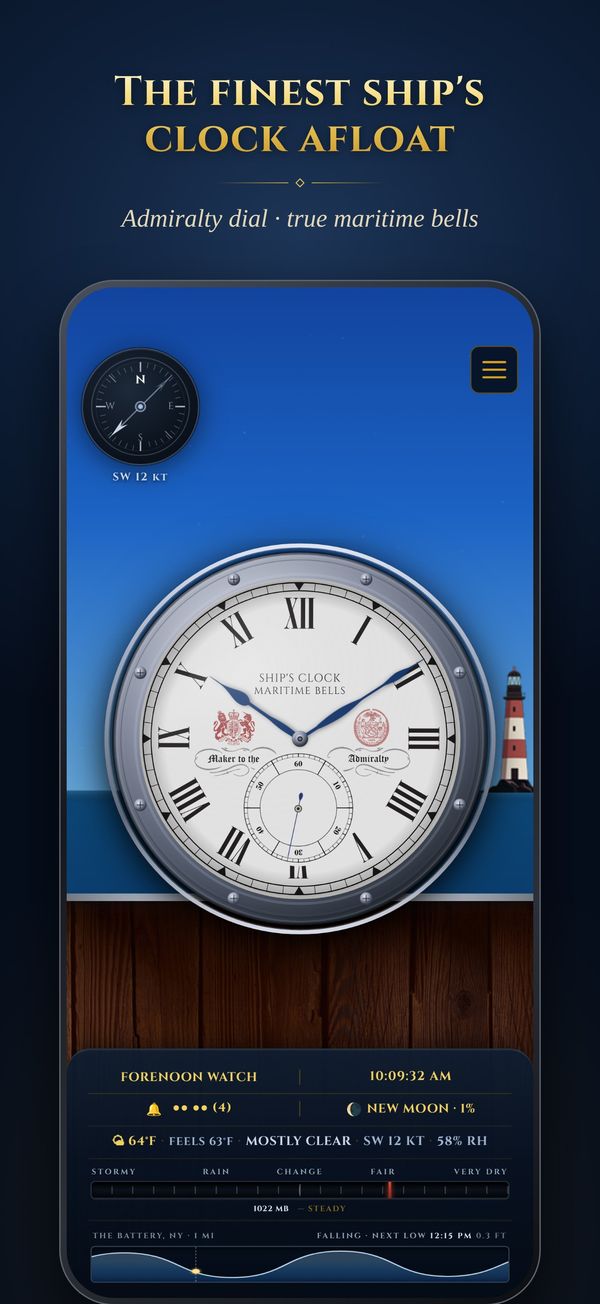
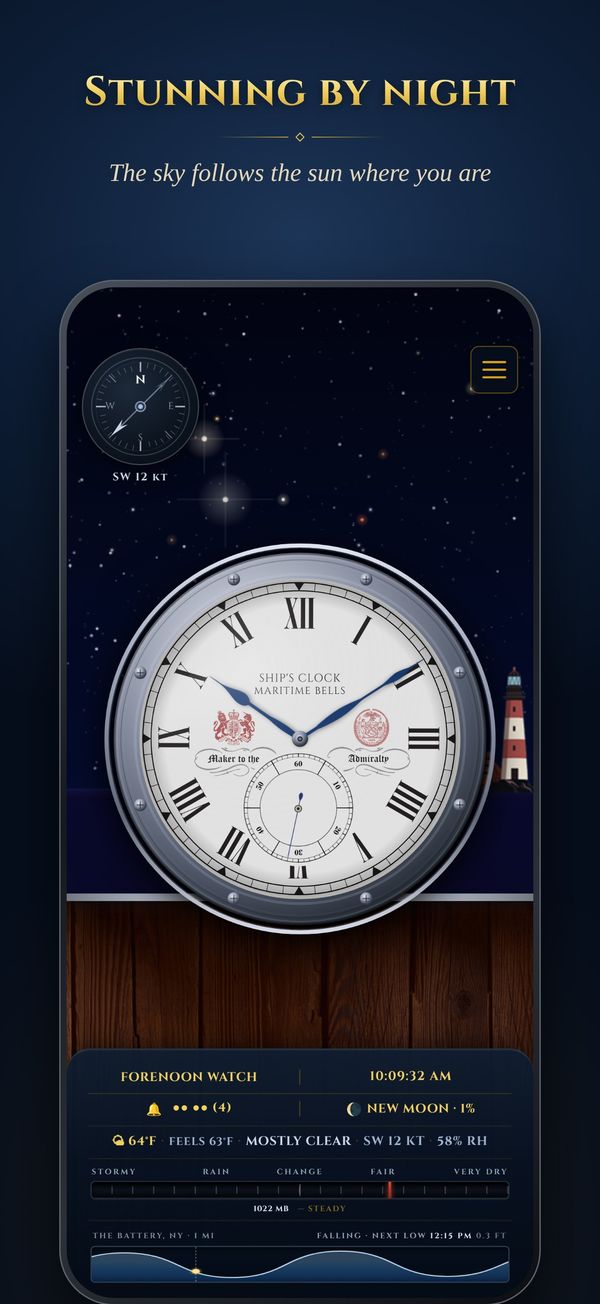
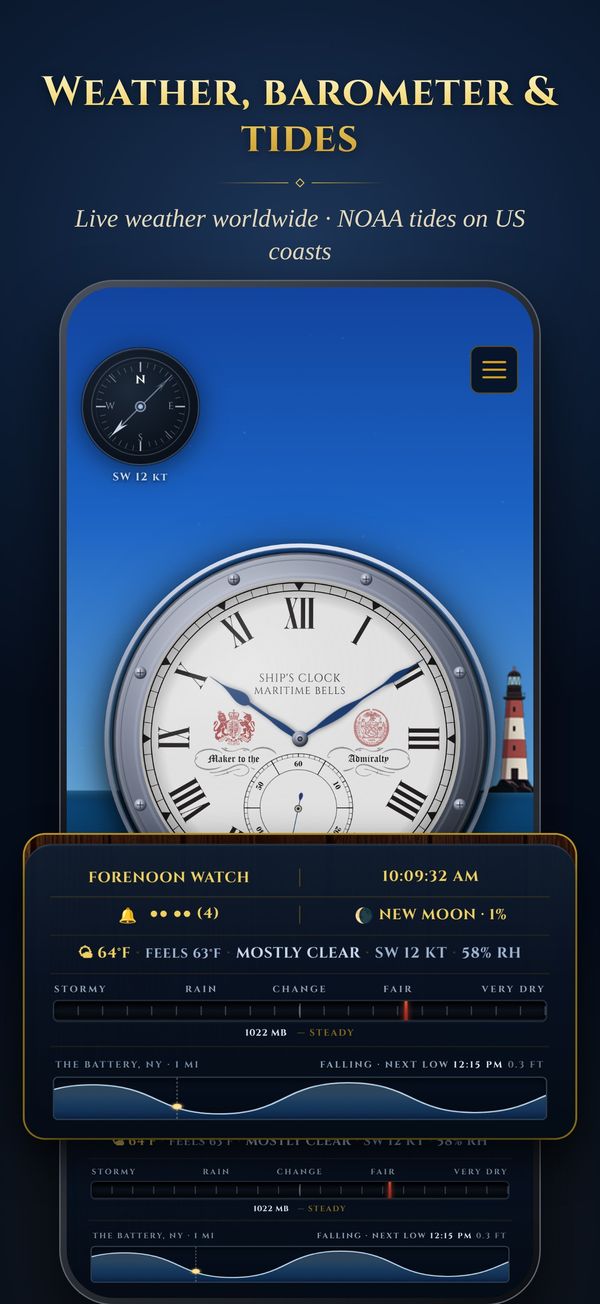
Today the same tradition fits in a pocket. Ship's Clock strikes the watch pattern every half hour, in pairs, with real recorded bells. It names the watch on deck, keeps quiet through the night if you ask, and rings in the background and on the lock screen. Choose the Royal Navy or U.S. style for the dog watches, and an Admiralty chronometer dial to read it by.


Sea Words the Bell Gave Us.
The end of a watch, and by extension the end of a sailor's life. "Eight bells and all's well."
One of the two short evening watches; now also any late or unpopular shift.
The middle watch, midnight to four; often said to be where the "graveyard shift" comes from.
Shaking the sandglass to make a watch end sooner; cheating the clock.
Speed measured by knots on a log line paid out over a short sandglass, and still the unit at sea.
Naval lore has the captain answering the report of noon this way before eight bells were struck.
Sources.
- The Ship's Bell, Naval History and Heritage Command
- Ship's bell, Encyclopaedia Britannica
- Bells on Warships, National Museum of the Royal New Zealand Navy
- HMS Lutine, Lloyd's of London
- John Harrison, Linda Hall Library
- Chelsea Clock Company, Wikipedia
- COLREGs Rule 33, IALA
The full bell chart, the seven watches, and what bell it is where you are right now.
Hear the watches ring on your phone, with Admiralty chronometer dials, tides, weather and moon.
Hear the Watches Ring.
Ship's Clock strikes the ship's bells every half hour on iPhone, Android and the web. Free to try, then one purchase for life. No subscription, no ads.